 Save to Pinterest
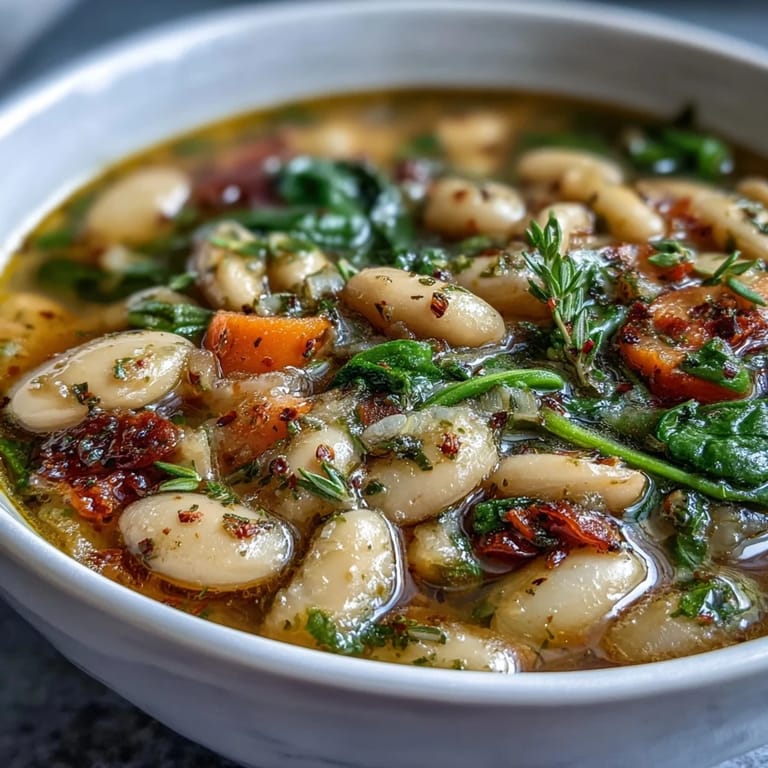
 There was a Tuesday evening when my neighbor knocked on my door with a basket of fresh spinach from her garden, and somehow that simple gesture turned into a full kitchen project. I'd been meaning to make something warm and honest, something that didn't require fancy techniques or ingredients I couldn't pronounce. Tuscan white bean soup felt like the answer—the kind of dish that tastes like it took hours but doesn't demand much fussing. That night, as the aroma of garlic and rosemary filled my apartment, I realized this soup has a way of making you feel like you've done something meaningful, even if you're just following intuition and stirring a pot.
I made this soup for my sister when she was going through a rough patch, and she sat at my kitchen counter, bowl in hand, just quietly eating while we talked about nothing important. That's when I understood—this isn't just soup, it's permission to slow down and be gentle with yourself. The warmth of it, the simplicity, the way it fills you without heaviness. She's asked me for the recipe at least a dozen times since.
Ingredients
- Extra virgin olive oil: This is where flavor begins, so don't reach for the cheap bottle; the fruity notes matter and will make your soffritto taste like something you actually want to eat.
- Yellow onion, carrots, and celery: This classic trio (soffritto in Italian) is the foundation—dicing them roughly the same size means they cook evenly and create a base that tastes like home.
- Garlic cloves: Three cloves minced fine will perfume the entire pot without overpowering it; fresh garlic is worth the extra 30 seconds of knife work.
- Dried thyme and rosemary: These herbs are the soul of the dish, so use dried if that's what you have—sometimes dried herbs are actually more concentrated and honest than fresh.
- Dried chili flakes: Optional but worth adding just a pinch; it wakes up your palate without announcing itself loudly.
- Cannellini beans: Draining and rinsing them removes the starchy liquid that can make soup taste metallic, and they'll absorb the broth flavors better this way.
- Diced tomatoes: Canned tomatoes are consistent and reliable; they've been picked at peak ripeness and preserved with care, which often beats fresh tomatoes in winter.
- Vegetable broth: Quality matters here—a good broth with actual flavor will make your soup taste like you've been tending a simmer all afternoon.
- Fresh spinach or kale: Added near the end so it stays bright and doesn't turn into something sad and gray; the wilting happens in seconds.
- Salt and black pepper: Taste as you go and season gradually; this soup will tell you what it needs if you listen.
- Fresh parsley: A small handful scattered on top adds color and a whisper of green, freshness that cuts through the richness.
- Lemon juice: Just optional, but a half teaspoon will lift everything and make people wonder why it tastes so bright.
- Unsalted butter: For the garlic bread, softened butter spreads smoothly and combines with garlic without any resistance.
Tired of Takeout? 🥡
Get 10 meals you can make faster than delivery arrives. Seriously.
One email. No spam. Unsubscribe anytime.
Instructions
- Build your foundation with the soffritto:
- Pour olive oil into your pot and let it heat until it shimmers slightly, then add your diced onion, carrots, and celery all at once. Stir them occasionally for 6 to 7 minutes—you're listening for a gentle sizzle and watching for the onions to turn translucent and soft.
- Wake up the aromatics:
- Add your minced garlic, thyme, rosemary, and a pinch of chili flakes, then stir constantly for about 1 minute until the whole pot smells like Italian countryside. Don't let the garlic sit still or it'll brown and taste bitter.
- Add the heart of the soup:
- Pour in your drained beans and tomatoes, then add the broth slowly so everything combines smoothly. Bring it to a full boil—you'll see the surface move and bubble—then immediately lower the heat and let it settle into a gentle simmer.
- Let time do the work:
- Leave the soup alone for about 20 minutes, stirring occasionally if you pass by. The flavors will deepen and marry, the beans will soften further, and the broth will taste less like separate ingredients and more like one complete thought.
- Finish with greens and seasoning:
- Dump in your spinach or kale and watch it shrink down to almost nothing within 5 minutes of simmering. Taste it now—add salt pinch by pinch, grind in some black pepper, and if you have lemon juice, squeeze in a tiny bit for brightness that makes people pause and ask what's different.
- Prepare the garlic bread while soup finishes:
- Turn your oven broiler on to preheat. In a small bowl, mash together softened butter, finely minced garlic, fresh parsley, and a small pinch of salt until it's spreadable and fragrant.
- Toast the bread to golden perfection:
- Spread the garlic butter over your baguette slices, lay them on a baking sheet, and slide under the broiler for 2 to 3 minutes—watch carefully because the line between golden and burned is thinner than you'd think. It should smell incredibly good when you pull it out.
- Bring it all together:
- Ladle the hot soup into bowls, scatter a small handful of fresh parsley on top for color, and serve immediately with the warm garlic bread alongside. People will eat this slowly, which is exactly the point.
 Save to Pinterest
 My mother called me one day and asked if I'd taught my brother how to make this soup yet, and I realized it had become something we pass along without even thinking about it. It's not fancy or complicated, but it carries something that matters—comfort, continuity, a simple way of saying I've got you. That's what honest food does.
The Magic of Slow Flavor Building
There's something that happens when you let vegetables soften in oil before adding anything else—the onions turn sweet, the carrots release a subtle earthiness, and the celery brings a quiet complexity that people rarely notice but always taste. This is called building a soffritto, and it's the difference between soup that tastes like separate ingredients and soup that tastes like love in a bowl. Don't rush this step by turning the heat too high; medium heat and patience create depth that high heat and hurry cannot.
Variations and Adaptations
This soup is forgiving and honest in a way that invites experimentation. You can add a parmesan rind while it simmers for a savory depth that's almost impossible to describe but unmistakably present when you taste it—just remember to fish it out before serving. If you like creamier texture, mash some of the beans against the side of the pot or use an immersion blender to partially puree the soup, leaving some chunks for texture. You can swap out spinach for kale if that's what you have, add a diced zucchini or white beans instead of cannellini, or even throw in some diced red bell pepper if your kitchen has one lingering in the crisper drawer.
Making This Soup Your Own
The beauty of rustic cooking is that recipes are starting points, not strict instructions carved in stone. I've made this soup with vegetable scraps I was going to discard, with whatever fresh herbs I had on hand, with day-old bread transformed into something purposeful. Every version turned out differently, and every version was exactly what we needed that night. This soup doesn't judge your improvisation; it celebrates it. Trust your instincts about what flavors belong in your kitchen.
- If the broth tastes weak, add a splash of lemon juice or a small drizzle of balsamic vinegar for invisible depth.
- Leftover soup tastes even better the next day, and it freezes beautifully for up to three months if you store it in a glass container with room for expansion.
- Serve it with something besides garlic bread if that's what your moment calls for—crusty breadsticks, focaccia, or just a simple salad on the side.
 Save to Pinterest
 This soup is one of those quiet recipes that doesn't show off but somehow always delivers exactly what people need. Make it when someone's tired, when you're tired, when the world feels like too much and all you want is something warm and honest waiting for you.
Recipe Questions & Answers
- → What beans are used in this soup?
Cannellini beans provide a creamy texture and mild flavor essential to the dish.
- → Can I substitute the greens in the soup?
Yes, fresh spinach or kale works well, adding nutrients and a pop of color.
- → How is the garlic bread prepared?
Slices of baguette are topped with a butter, garlic, and parsley mixture then broiled until golden and fragrant.
- → Is it possible to make the soup creamier?
Mashing some beans or partially pureeing the soup adds a smoother, creamier texture.
- → What herbs enhance the flavor?
Dried thyme and rosemary lend aromatic notes that complement the beans and vegetables.
- → Can this dish accommodate dietary preferences?
Using plant-based butter and gluten-free bread can adapt the dish for vegan and gluten-free diets.